
Menu

Blog

Category: Accelerator

Summer Accelerator Spotlight: Slolar

Slolar co-founders (from left to right): Russell Caletena, Yash Desai, Paul Romano, Fernando Estevez. Photo by Willa Westneat.

Four Cal Poly engineers are working to empower residential solar panel owners to take action and accelerate their return on investment with Slolar, a startup founded by electrical engineering graduate Russell Caletena, mechanical engineering graduate Paul Romano, computer engineering graduate Fernando Estevez and computer engineering fifth year Yash Desai. The Slolar team is developing technology that will provide solar panel owners with predictive data analytics pertaining to their solar panel performance.

“Solar panel owners have absolutely no idea the amount of [money] that they’re losing out on each year,” Desai said. “We hope to bridge that gap so that they get the most out of their panels, and also do good for the planet.”

The idea for Slolar originated in September of 2020, when the co-founders met through Experience Building a Startup, a three-quarter senior project course in which business and engineering students can practice problem-solution skills, customer development, prototyping and user testing by building their own business. 

The interdisciplinary nature of the course appealed to the Slolar co-founders, who wanted to expand their education beyond the technical skills taught in their engineering courses.

“The reason why I wanted to pursue business and entrepreneurship is because of Cal Poly’s strong programming,” Caletena said. “I realized, as an engineer, I wanted to broaden my scope and develop some soft skills with respect to developing a business — what it means to take a product to market and everything that happens behind the scenes.”

Cal Poly’s Experience Building a Startup course provided the Slolar team with the unique opportunity to explore the crossover between entrepreneurship and engineering.

“As a mechanical engineering student, I really wanted to bridge the gap between engineering and business… and the entrepreneurship senior project was a great way to do that while still focusing on engineering,” Romano said.

Course professors Dan Weeks and Tom Katona encouraged the co-founders to pursue Slolar as not only a senior project, but as a potential startup endeavor.

In April of 2021, the Slolar team brought their idea to Innovation Quest (iQ), an annual business plan and prototyping competition hosted by the Cal Poly Center for Innovation and Entrepreneurship (CIE). Although they did not place, the Slolar team did not let the loss discourage them. 

They applied to the CIE Summer Accelerator, an intensive, summer-long program that helps Cal Poly students and recent graduates develop their startup ideas into real, sustainable businesses. They were one of the nine teams accepted to the program. 

The Summer Accelerator program provides the Slolar team with opportunities to gain practical experience that helps the team of engineers better understand the processes behind entrepreneurship.

“There’s so much support for the entire startup realm,” Desai said. “You don’t normally see that anywhere else. I mean, this is truly the best extension of Learn by Doing, where you actually are getting the support outside of the classroom needed to apply what you’ve learned inside and take it outside.”

The Summer Accelerator provides the Slolar team with an in-depth view into the startup process, but with a team composed entirely of engineers, their process differs from that of a classic entrepreneur. 

“We’re very systematic in our approach towards everything — I think a little more than average because of our engineering backgrounds,” Desai said.

Their engineering backgrounds also influence the way in which the Slolar team approaches problems in entrepreneurship.

“All of us are engineers, so we love the idea of problem-solving,” Estevez said. “We like to break down these complex problems that we might face on the daily, break them into smaller, little pieces and tackle them head on. It’s just what we’ve been taught.”

To keep up with Slolar, visit beacons.page/slolar, follow them on Instagram at @slolar.co or catch them at Demo Day on Sept. 14.

Comments are off for this post

A Conversation With An Accelerator Team

In 2019, Ryan Murtaugh and Nathan Brickman, now graduates of biology and agricultural communications respectively, set out to tackle a problem in the mental health industry: it’s outdated communication tactics. What began then as a class project has now developed, through several CIE programs, into incubator company Bridge.

Q: At its core, Bridge is a software platform designed for mental health professionals to communicate more efficiently. Why create this?

Ryan Murtaugh: Right now, mental health professionals are utilizing all kinds of different software, even Facebook, to do things pretty inefficiently. Our collaboration software will strengthen the mental health industry’s infrastructure, enabling professionals to connect with each other, refer clients and grow their practices on a modern platform that’s designed for them.

Q: How did this idea come about?

RM: Nathan and I met in John Townsend’s “Intro to Entrepreneurship” class where we decided to look at the mental health industry, figure out what problems existed in that space and utilize technologies to mitigate some of those problems. Everyone has been personally affected by mental health in some capacity, so we felt that it was really fitting to look at that space.

Q: So, you devised this new business concept for class. Then what? 

RM: After the class, we joined the Hatchery, then applied for the 2019 accelerator — and didn’t get in! That was actually great for us, though. Rather than going into the accelerator with a half-baked idea, we were able to really dive deep into the industry’s problems in a HotHouse MedTech program that summer.

Q: Then you reapplied to the HotHouse Accelerator in 2020?

RM: Yes! We got into the accelerator the next summer. When we first came into the program we had some more hypotheses to test and unfinished development, but by the end of it we had a software with mental healthcare professionals using it daily. The program really gave us the time and resources to strategize and develop the software.

Q: When it comes to resources, accelerator teams are given $10,000 in funding. How did that help Bridge?

RM: The $10,000 was so helpful. Software sometimes seems as though it isn’t that costly, but it can add up. The money helped with simple things like keeping our servers running or paying for APIs, but it also allowed us to really test things and get crucial data points that helped us move forward a lot faster.

Q: What does it mean for students like yourself to have CIE resources? 

RM: It’s incredible. The CIE is the best thing you could possibly have as an entrepreneurial student because you have access to this network of people who have done it before and are happy to guide you. Thinking back to freshman me, I always knew I wanted to go into entrepreneurship and start my own venture. Just knowing that CIE resources were on campus really motivated me to go for it.

Q: It’s hard to imagine students not having a resource like that to support them.

RM: Exactly. It’s such a huge endeavor to even try entrepreneurship in general. Without experienced people to help you through it, it must be exponentially harder.

Q: And you can’t learn everything on YouTube, right?

RM: Nope. And I tried, trust me! I know it’s cliche, but it’s so true about Learn by Doing at Cal Poly. I’ve learned more in the past two years working on Bridge than I have my whole life, in almost every regard — personal development, professional development, business knowledge. Everything.

Q: That’s huge. So, what about the challenges of entrepreneurship? I imagine it wasn’t all smooth sailing for the Bridge team.

RM: The CIE makes it really clear that pivots and iterations are extremely common and there’s no point in fearing the inevitable. For us, there wasn’t a whole lot of pivoting, but rather more understanding of the true complexity of the mental health market. While we’re still on the path of focusing on private practices first, our product roadmap has evolved to include strategic developments for other entities to make Bridge a fully integrated, collaborative experience.

Q: Did COVID-19 change anything?

RM: COVID-19 has been really interesting. With mental healthcare, it’s been fascinating. The switch to telehealth set a new precedent that many mental health professionals do not need to be in a certain place to do their work. And the methods practitioners were using before were so outdated, like sending letters or using a Rolodex to call your colleagues. It’s crazy. Of course, COVID-19 isn’t good, but for Bridge, it’s really been a push in the right direction and kind of forced this industry to adopt new technologies.

Q: Now that you’ve graduated from the accelerator, what’s next for Bridge?

RM: Well, we just moved into the HotHouse Incubator which has already been extremely helpful in getting our advisory board together and working toward incorporation. Right now, we’re doing closed beta testing and are working to hit about 300 to 600 practitioners [on Bridge] by December. Then, by June of 2021, we hope to have around 10,000 users and start really turning on the revenue streams. At this point, it’s just total focus and execution on that pathway.

Comments are off for this post

Eight Student Startups Venture Forward with Entrepreneurship

Sidewalk art reading "Passion led us here"

While a pandemic swept over the globe causing universities to go virtual and the economy to take a hit, eight student startups set out to prove that innovation doesn’t stop in the wake of challenges, but rather is ignited by them.

These startups, ranging from an intelligent environmental sensing platform to a curated snack subscription box, are solving real-world problems through the Cal Poly Center for Innovation and Entrepreneurship (CIE) HotHouse Accelerator program despite running headfirst toward ever-evolving obstacles.

For Nathan Brickman, agricultural communications graduate and co-founder of accelerator company Bridge, his startup’s mission of improving the mental health care industry has recently become an even more important pursuit amid current world issues. 

“We are in a global pandemic, which is a huge public health scare, and associated with that is not just a threat to our physical health, but certainly our mental health as well,” Brickman said. “We expect to see a rise in demand for mental health services, so for us it’s a really important time to help clients that are seeking care.”

Along with Bridge, other accelerator startups have also come to recognize heightened opportunity in the past months. 

Imperium, a startup founded by seven students, is working to maximize the usability of coworking spaces through limitless access to power, which the team expects to be increasingly important as the traditional workplace continues to evolve out of work-from-home measures and social distancing.

One of Imperium’s co-founders, mechanical engineering senior Jamie Jenkins, also noted that not only is now an incredible time to innovate industries in need of an upgrade, it’s also a great time to take a leap of faith into entrepreneurship.

“Starting a startup is a really uncertain task in general,” Jenkins said. “But somehow taking on additional risk or starting something in already uncertain times feels kind of reasonable.”

Vince DeSantis, a business administration graduate and founder of accelerator startup Fruji, had the same opportunistic outlook as Jenkins.

“I was challenged by a friend to pursue Fruji and see if it could become something because, well, what did I have to lose?” DeSantis half-joked after explaining that he lost a job offer due to the pandemic. “The job market isn’t great right now… so I decided it was the perfect opportunity to dive right into [the accelerator program.]”

For all of the accelerator companies, any nerves of venturing into the startup world were outweighed by trusting the guidance within the HotHouse Accelerator program.

Plus, with five of this year’s accelerator companies lacking members with a background in business, the CIE plays an integral role in supporting these young entrepreneurs with business mentorship in order for them to make strong innovative changes to the world.

So, while the CIE has always focused on supporting student entrepreneurs through its several programs and resources, that priority has only heightened in this time of rapid change and uncertainty. 

To explain the overall feelings of the 2020 accelerator startups, Danielle Petrocelli, a business administration graduate and Imperium co-founder, said it best:

“We’ve all taken the perspective of ‘let’s just do this and learn a lot and give it our all,’” she explained. “Maybe this isn’t the traditional job that we were all expecting, but we’ve all been given the opportunity to really work hard on [our startups] now and I think just having that perspective will work in our favor.”

Stay tuned to see how these eight student startups continue to venture forward over the 12-week accelerator program on Instagram, Facebook, Twitter and LinkedIn.

Comments are off for this post

Graduated Accelerator Company: Wayve, Inc.

Sierra Scolaro went from working on a senior project while finishing her undergraduate degree to becoming a CEO in one year.

What got her there? The HotHouse Summer Accelerator. 

“When we started at the beginning of the summer, we were just three people with an idea and a really not-so-great prototype,” Scolaro, CEO of Wayve, Inc., said. “Going through the accelerator program with all of the mentorship, the dedicated office space and the $10,000 gift really propelled us forward.”

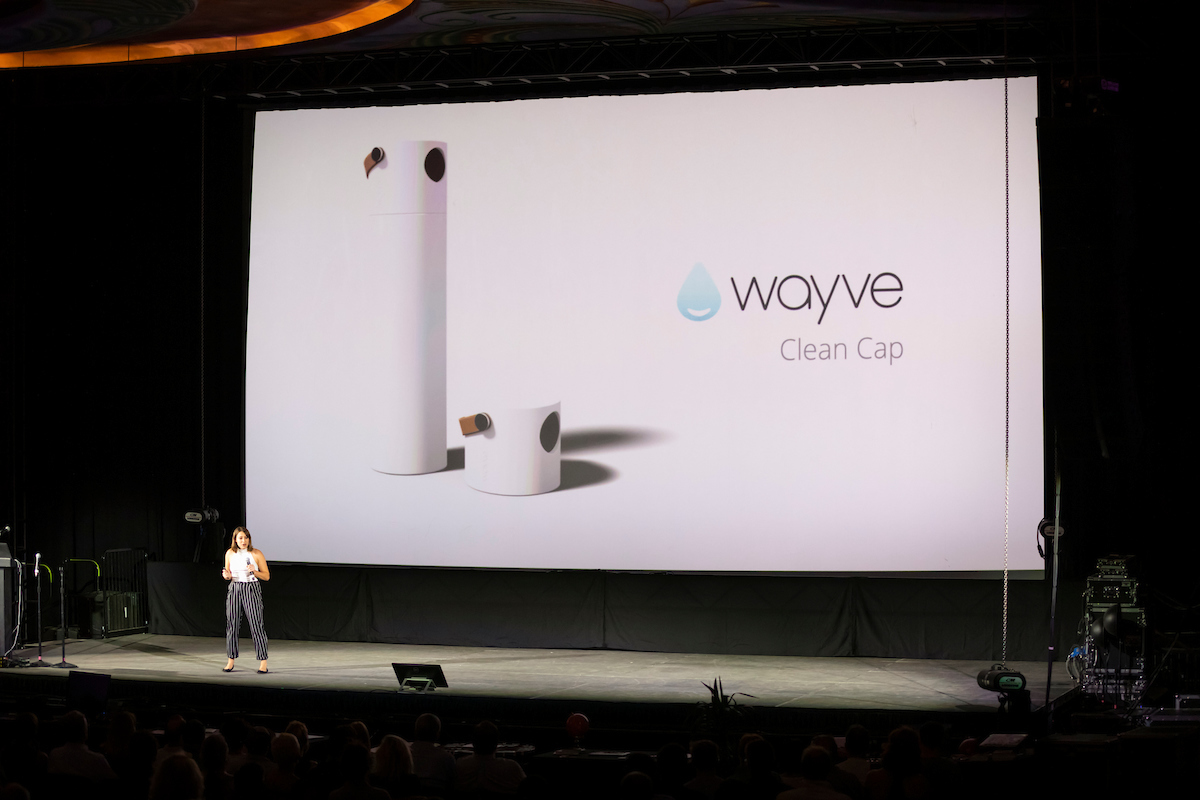
The Wayve team was able to utilize their $10,000 in startup funding from the Cal Poly Center for Innovation and Entrepreneurship (CIE) to prototype and patent their idea of a reusable water bottle that allows for filtered water from any spout.

While the business-development side of the program is what directly helped Wayve grow this idea into a company, she also believes the atmosphere of the HotHouse made the summer even more impactful.

“The best thing about the accelerator has to be the community,” the business entrepreneurship graduate said. “When you’re surrounded by all of that energy and other people working on their passions, it makes you all the more excited to pursue your own.”

Scolaro is grateful that she still has the support and motivation she needs to continue advancing her startup since graduating from the accelerator and joining the CIE’s two-year incubator.

“Now that we’re in the incubator program, it’s definitely not as much hand holding as the accelerator, but it’s not like all the support just disappeared,” she explained. “Working out of the HotHouse Annex, surrounded by other entrepreneurs, really provides an energy to keep the momentum going.”

Scolaro says her team really values the mentors, funding opportunities and network of helpful people they have now, but notes that a lot of these resources were first gained through the HotHouse Accelerator. That alone, she said, is enough of a reason to apply for the program.

Plus, she truly loves that the program allowed her to be an entrepreneur.

“I want to enjoy life and I want to enjoy work and I don’t want there to be a distinct separation between the two,” she said. “If I have the opportunity to create that for other people as well, to employ someone who loves what they do and feels like they’re contributing to an overall larger mission for the world, I would love to.”

So, to anyone considering taking their innovative ideas to the next level and building their business community, Scolaro has just one bit of advice for Cal Poly’s aspiring entrepreneurs.

“The HotHouse Summer Accelerator had to be one of the best summers of my life,” she said. “If you’re on the fence, just do it. There’s nothing to lose.” 

Take the leap, launch your dream business, and spend your summer in San Luis Obispo with the HotHouse Summer Accelerator. Find out more and apply for the program at https://calpolycie.wpengine.com/launch/hothouse-accelerator/

Comments are off for this post
1 4 5 6