
Where Are They Now? Accelerator 2025
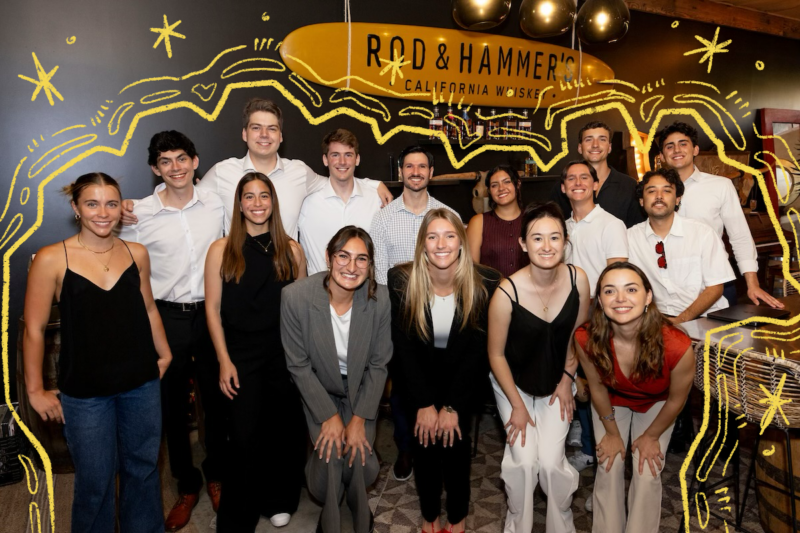
It’s been ten months since the 2025 Cal Poly Center for Innovation and Entrepreneurship (CIE) Summer Accelerator wrapped up. Throughout the 12-week program, Cal Poly students and recent graduates dedicated their summer to turning early-stage ideas into tangible ventures building out their business models and learning what it really takes to launch a company.
The program concluded with Demo Day, where each team took the stage to pitch their startup and share the progress they had made over the summer.
Now, months later, the 2025 cohort has taken the momentum they built and channeled it into exciting new directions, whether that means continuing to grow their startups, pivoting to something new or carrying the lessons of the Accelerator into what comes next.
Here’s a look at where each team is now:

One Fountain Health
One Fountain Health set out to help people maintain their independence through smarter medication management. Their automated pill dispensing system was designed to eliminate the most cumbersome aspects of managing medication.
Co-founders Eli Lazar (Business Administration, ’25) and electrical engineering master’s student Victoria Asencio-Clemens (Computer Engineering, ’25) brought complementary skills to the team and transformed their idea from a class project into something much bigger.
“The Accelerator completely changed our approach,” Asencio-Clemens said. “Our idea went from a class project to a company and we had to figure out what that meant for us. Instead of thinking about what we felt the best solution would be, we had to find a concrete product-market fit that allowed us to stay on mission while creating something that would financially succeed.”
For Lazar, the Accelerator’s most lasting impact was personal as much as professional. “The Summer Accelerator empowered me to be the CEO of my own life,” he said. “After the summer, I knew what I wanted to work towards and how to get there.” Learning to trust his own instincts became one of his biggest takeaways.
Though One Fountain Health is no longer active as a startup, both founders carry its lessons forward in meaningful ways.
Lazar has channeled his experience into a new pursuit entirely, taking a job as an elementary school music teacher while simultaneously earning his teaching credential. He sees a direct line between what he learned in the Accelerator and his ability to step confidently into that role. “We were trained to make decisions that we felt confident in and see if they worked out later,” he said. “I couldn’t have expressed my autonomy in that way without the Accelerator.”
Asencio-Clemens returned to Cal Poly to pursue a master’s degree in Electrical Engineering, focusing on medical and rehabilitation devices. She credits the Accelerator with reshaping how she approaches problems across the board. “We did all different kinds of research — patent searches, focus groups, interviews,” she said. “It changed the way I look at problems in all aspects of my life.”
She also leaves the experience with a clearer sense of where she’s headed with more confidence in her ability to be part of future teams, as a founder or an employee, because of the insider perspective she gained throughout her startup journey.
As for what the Accelerator ultimately taught them about success, Lazar put it plainly: “People may measure this program by how many startups survive, but that’s not the only metric that matters. Our hypothesis may have been wrong. Our idea may have been wrong. Our willingness to learn and grow from that was right.”
Vandra
When Alex Malone (Agricultural Business, ’26) and business administration senior Wian Roothman entered the Accelerator, Vandra was a probiotic-rich frozen dessert made with dairy-based kefir. The idea was born from Malone’s personal experience growing up relying on kefir to support a compromised immune system. The mission was to make gut health accessible and enjoyable, replacing supplements with something people actually wanted to eat.
The Accelerator taught the team how to pivot. As the program pushed them to dig deeper into their business model, finances and long-term vision, Malone and Roothman began to realize that ice cream wasn’t the direction they wanted to go. The logistical challenges of a frozen product with a short shelf life only reinforced their decline in passion for the idea.
Shortly after, they pivoted to a new product: energy lollipops for concerts and festivals. “With the lollipops, we could work on it day and night and never tire,” Malone said.
The pivot proved to be the right call. Still operating under the Vandra name, the team has built an entirely new brand around caffeinated functional lollipops and is now months away from their official launch. You can find them at thevandra.com and on Instagram at @vandralollipops.
Looking back, Malone credits the Accelerator with giving them the foundation to move fast and build smart. “I learned how to start a company in 12 weeks,” she said. “Never forget a name and talk to everyone. Those are lessons I carry everywhere.”
With their launch approaching in June and Roothman set to graduate, the team is focused on building Vandra into something profitable enough to support them both full time.
Devscribe
For developers, one of the biggest headaches isn’t writing code, but keeping Application Programming Interface (API) documentation up to date. Co-founders Gianni Hart (Business Administration, ’25) and Samuel Solano (Computer Engineering, ’25) created an AI-powered platform that automates API documentation, generating clear, brand-tailored docs that update automatically as code evolves, saving developers time and keeping teams on the same page.
Since the Accelerator, Devscribe has been heads down building their product. The team spent three focused months perfecting their product before turning their attention to sales and growth. “We decided we wanted a great working product because our switch cost for customers might be high,” Hart said. That patience paid off, as Devscribe finished their product in March and within two weeks of outbound sales, had landed three paying customers, bringing in roughly $1,000 in monthly recurring revenue.
The team is also now part of Founder University, a 12-week accelerator hosted by Jason Calacanis and Launch Co., where they continue to sharpen their approach to growth. Despite working fully remotely across time zones, the team has found their rhythm through a daily 30-minute check-in to keep them aligned and moving forward together.
The Accelerator, Hart says, instilled a willingness to throw out what isn’t working and start fresh without hesitation. “During the Accelerator, Sam and I had multiple weeks in a row where we completely started our pitch over trying to find the right way to convey our vision,” he said. “Today we use that same approach to product and sales. If something isn’t clicking, no worries, try a new path.”
The lesson that has stayed with them most is to remain “simple, simple, simple,” Hart said. “To this day, I still catch myself trying to over-explain in a technical manner and have to slow down.”
Ecoplasticity
Ecoplasticity is on a mission to tackle two environmental problems at once: sargassum, an invasive seaweed that blankets coastlines from Florida all the way to the Caribbean, and the plastic lining on takeout containers that ends up in landfills. Mayela Fernandez (MBA, ’25) and polymers and coatings master’s student Michelle Cullen are developing a biodegradable coating that replaces that plastic lining, making paper food packaging fully compostable and anaerobically digestible.
Since the Accelerator, Ecoplasticity has been moving fast. The team found a lab in San Diego, expanded their advisory board with experts from the packaging and coatings industry, and are preparing for their first commercial pilot. They were also selected as finalists for AngelCon 2026, where they took home the Audience Choice Award, and have been active in competitions and events, including LA Climate Week, VenTech, and Pepperdine’s Most Fundable Companies. Fernandez also received the Young Leaders Award from Walking Softer, recognizing her work as a climate founder.
One of the biggest shifts since the Accelerator has been product refinement, driven directly by customer discovery. “With further talks with potential customers, we discovered that there is a market for an oil-only barrier coating, giving us a faster path to market,” Cullen said. The team has since narrowed their focus to fine-tuning that formulation, with plans to begin pilot trials within the next few months while keeping the full oil and water barrier coating in their long-term roadmap.
“The Accelerator prepared us by refining our value proposition, knowing the pain points of our customers through customer discovery and understanding the market,” Fernandez said. A key validation moment came when the team confirmed that their invasive seaweed material could be used specifically for paper packaging solutions.
Both founders are now balancing Ecoplasticity with their academic pursuits. Cullen is completing her master’s degree in Polymers and Coatings at Cal Poly with plans to graduate this June, while also in the midst of a nine-month internship as part of her degree requirements. Fernandez, now based in San Luis Obispo but planning a move this summer, is working on Ecoplasticity full time and is part of both the Cal Poly CIE Incubator and the LA Blue Accelerator. Both programs have proven to be incredibly helpful as the company grows more complex in navigating the bigger challenges of building a business, from product roadmap decisions to financial modeling.

Elora
Drink spiking is a threat that millions of women navigate every time they go out. Elora is building a solution that doesn’t ask them to compromise style or safety. Co-founders Addison Bounds (Business Administration, ’25) and biomedical engineering master’s student Kiara Robichaud are embedding drug detection sensors into aesthetic jewelry, giving users a discreet way to test their drinks and receive an instant alert on their phone if date-rape drugs are detected.
Since the Accelerator, Elora has hit several milestones. The team has raised $85,000 toward their pre-seed round, incorporated as a C-corp, filed toward a provisional patent and are deep into polymer development for their electrode coatings. They also took first place at the Embark Collective pitch competition in Tampa, Florida, and were selected as one of 1,500 teams — out of 18,000 applicants from over 130 countries — to advance to the second round of the 2026 Hult Prize.
For Bounds and Robichaud, the motivation to keep pushing came into sharp focus right after Demo Day, when two young women reached out on Instagram to share their drink spiking stories. “Having these women reach out and share not only their stories, but their gratitude for what we are creating, sets us on fire to keep going as fast as we can,” they said. “It was a reminder of why we are taking risks and making sacrifices to solve this problem.”
The Accelerator gave them the foundation to move with both confidence and intention. Steady goal-setting, leaning on key mentors and learning to trust their instincts all became core to how they operate. Their pitch deck being refined over countless hours during the Accelerator has become one of their most valuable assets. “I am so grateful for the time that went into our deck,” Bounds said. “We use it so much, and it’s nice to feel so confident in it.”
Understanding their financials and how to build forward-looking projections for a scalable startup also proved critical as they began meeting with investors. The Accelerator gave them the foundation to walk into those conversations with confidence, such as knowing how to pitch, how to engage with investors, and how to make decisions under pressure.
The lesson that has stuck with them most is simple but powerful: focus on the next step in front of you, and trust your gut. “No one knows your company like you do,” they said.
Both founders have been balancing Elora with demanding academic and athletic schedules. Bounds is completing her MBA at the University of South Florida and wrapping up her final season as a Division I beach volleyball player, set to graduate in July. Robichaud recently defended her thesis to earn her master’s degree in Biomedical Engineering and currently serves as the Graduate Assistant for the Cal Poly Beach Volleyball team. Their next plans are to go full time in August and complete validation testing of two Schedule IV drug-facilitated rape drugs.
NeuRelief
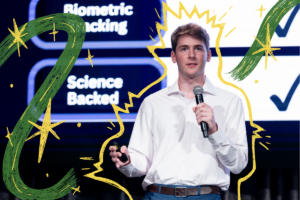
Insomnia affects millions of people, and most treatments haven’t evolved in decades. Biomedical engineering master’s student Rex Walker and Jeremy Laufer (Biomedical Engineering, MS ’25) developed a sleep mask that gently stimulates the vagus nerve through personalized earpieces, while tracking biometrics to optimize treatment for each user.
After the Accelerator, the team continued pushing early product development forward through the fall before Walker made the personal decision to step away from NeuRelief in December. It wasn’t easy, but working through that decision became its own kind of lesson. “You can’t always get what is 100% right for you on your first try,” Walker said. “If you trust yourself and stay focused on the same general direction, you will keep progressing, and the path might not look like anything you could have anticipated.”
The Accelerator itself, Walker says, was the most valuable experience of his time at Cal Poly. “It pushed me harder than any coursework ever did, and I genuinely enjoyed it every day,” he said. The program sharpened his ability to identify problems worth solving, navigate FDA and market considerations for medical devices, leverage his network and prioritize progress when everything is pulling in different directions at once.
Today, Walker is finishing his master’s degree in Biomedical Engineering and channeling his experience into a new area of focus: data gaps in women’s health. He has been exploring solutions around perimenopause care and postpartum reproductive health monitoring, working alongside industry professionals and researchers in the femtech space to identify where data-driven tools are needed most.


