Menu

Blog

Category: Incubator Company

You Already Launched Your Company, So Why Join an Incubator Program?

Three-person business team working together in the SLO HotHouse Incubator program.

The Cal Poly Center for Innovation and Entrepreneurship (CIE) doesn’t just want to help businesses launch — we want to help businesses thrive. That’s why joining the HotHouse Incubator program can still be a game changer even if your business is already launched and you feel like you can find success on your own. Here’s how our two-year incubator program helps entrepreneurial ventures prosper at any stage.


Expert Mentorship

You might be thinking, “I managed to get to where I am by myself, so why would I need a mentor now?” Well, one of our incubator startup founders, David Bartolomucci, put it best when he asked, “Why not learn from others’ mistakes first instead of making them yourself?” At the CIE, we simply believe that there’s no reason not to have mentor guidance along your entrepreneurial journey. For this reason, our HotHouse Incubator program offers one-on-one mentorship from Cal Poly CIE Small Business Development Center (SBDC) expert consultants and Cal Poly alumni to help you celebrate the highs and navigate lows of being a CEO. 


Networking for Growth

Gaining connections is oftentimes the ultimate factor for success and the best way to reach people is, well, through other people (and not just on LinkedIn). Being in the incubator program offers access to mentors, investors, seasoned entrepreneurs, innovative Cal Poly students, local businesses and everyone in between. Being a part of the HotHouse community lands you countless opportunities to expand your reach, expand your team and expand your funding… all things that are incredibly important at any stage in business.


Encouragement and Accountability

While mentorship and networking bring you business growth, they also bring you human connection. According to one of our former incubator program startup founders, Sierra Scolaro, “What’s really nice about having the CIE as a support system is that they’re not just supporting your business idea, they’re supporting you as an entrepreneur.” Being in the program brings you a community of like-minded people who are excited to watch you grow your business as well as your personal self, all while keeping you accountable in reaching your entrepreneurial goals.


“Human Google”

Whether you’re months away from launching or you’ve been in business for years, running a company definitely offers a never-ending level of uncertainty and probably a lot of Google searches. However, incubator company founder Trent Ellingsen calls the HotHouse “human Google” and it makes a great deal of sense. 

Our HotHouse Incubator program allows you to be surrounded by an interdisciplinary and diverse group of people who most likely have an answer to any of your questions (especially the ones that can’t be found with a simple web search). Joining the incubator can relieve you from a ton of uncertainty, confusion and wasted screen time. 


Tangible Resources

Along with all of the benefits from interpersonal connections in the program, the HotHouse Incubator program offers incredible workspace resources. Between the downtown SLO HotHouse and the HotHouse Annex, the CIE’s two off-campus locations, you can gain personal office space, private phone booths, tech-savvy conference rooms, spacious lounge areas, kitchen amenities and even a manufacturing lab for your hands-on innovations.

If you’re ready to take your already launched business to the next level, the CIE is here to help. Learn how your company can thrive with our strategic guidance, #SLOcal business network and energetic workspaces at https://calpolycie.wpengine.com/launch/hothouse-incubator/.


Comments are off for this post

Calwise Spirits Co. Stays Resilient by Turning Obstacles into Opportunities

Three Calwise Spirits Co. liquor bottles.

The entrepreneurial journey is full of risk, complex challenges and unpredictability, but Aaron Bergh, the founder of Calwise Spirits Co., says that unwavering resilience is what will get a startup through obstacles and on a path toward success.   

Bergh has gone through several Cal Poly Center for Innovation and Entrepreneurship (CIE) programs to grow Calwise into the distillery and tasting room that it is today, encountering several highs and lows along the way. 

Recently, he has met his biggest challenges yet.

“Since I started my business I’ve been very good at predicting things, but the pandemic has turned that all on its head,” Bergh said. “There’s absolutely no way to prepare for what’s going to happen next.”

However, Bergh accepted that instead of preparing for specific market changes and setbacks, all he could do was prepare his business to roll with the punches on a nearly day-to-day basis. 

When the COVID-19 pandemic first hit, Calwise was forced to close its doors and Bergh had the heavy burden of laying off his staff. Almost immediately, though, Bergh recognized an opportunity for his distillery.

“I turned my business into something it was never designed to be, which was a hand sanitizer manufacturer,” he said of his temporary pivot. “That allowed me to bring revenue in while a lot of people didn’t have that opportunity. I was able to bring my employees back and build up some funds to move forward and continue to grow my company.” 

As San Luis Obispo began to reopen its economy, Calwise then started to pivot back to business-as-usual but was quickly shot down by the second wave of restrictions on the local business community. Now, Bergh and his team are innovating their practices again by creating outdoor seating for Calwise customers to align with current public health mandates.

But why would he keep pivoting when things could change in an instant? Bergh said it’s just simply what you do as an entrepreneur.

“Having obstacles keeps me on my feet and forces me to constantly have to think and innovate,” he said. “When I’m faced with something tricky that would frankly make a lot of people want to run away and give up, I prefer to rise to the challenge.”

So, while Bergh says he has always been a tenacious problem-solver, going through the CIE HotHouse Accelerator and Incubator programs helped him better understand the need to stay resilient in the startup world.

“As simple as it sounds, the main thing I’ve learned is that everyone has challenges and that you just have to get through it,” he said of working alongside other startups and mentors. “Resilience means being able to survive through whatever is thrown at you and that’s exactly what we’ve been doing.”

Today, Bergh says that his team’s resilience has allowed business to go better than he expected it would during these economically-challenging times and that he’s found a silver lining in being able to steadily continue to sell Calwise spirits and cocktails online.

You can learn more about this persevering entrepreneur’s company at http://www.calwisespirits.com/ or find out how the CIE can help your company navigate the turbulent startup journey at https://calpolycie.wpengine.com/launch/hothouse-incubator/.

Comments are off for this post

CIE Graduates Keeping it SLOcal: Motoroso

Founder of Motoroso sitting on the roof of his black pickup truck on the beach.

Alex Littlewood didn’t land in San Luis Obispo by chance nor did he grow his startup here out of sheer convenience — in fact, he strategically chose the Central Coast over San Diego and Silicon Valley to do so. 

When Littlewood began building his startup Motoroso in 2014, he was based out of the Bay Area, a place that many would cite as the entrepreneurial epicenter. Upon getting accepted into the Techstars Accelerator, he moved the company to San Diego but decided to leave a year later in 2017.

Then, instead of returning to Silicon Valley, Littlewood found himself en route to San Luis Obispo.

“The decision to move to San Luis Obispo was primarily because I wanted to live here and wanted to build a company here,” Littlewood said. “It’s a place where people are realizing that one of the best ways to build a robust local economy is by supporting and growing entrepreneurship in the area.”

About six months after the move, he joined the Cal Poly Center for Innovation and Entrepreneurship (CIE) HotHouse Incubator to build Motoroso into what is now the first-ever platform for automotive and powersports enthusiasts to seamlessly share, discover and purchase parts for vehicular projects.

“I really, really like what the CIE and SBDC have done [with the program] in bringing everyone from the campus level to the community level all together into a single space where people can collaborate,” he explained. “Having that environment is what really makes entrepreneurship work.”

Now that Motoroso has graduated from the two-year program and officially launched in 2019, though, has Littlewood thought about leaving the area? 

Not a chance.

He said that while so many people get the impression that they should start a company somewhere small then move it to the Bay Area, he “honestly can’t think of a worse decision.” 

“It’s not a conducive place for startups anymore,” Littlewood explained. “There’s less noise in San Luis Obispo with fewer companies, so it’s much harder for startups that are nonsense to hide out in the mess just because they just have the right connections, like in the Bay Area.”

Despite the Central Coast being known for its wine country, beaches and laid-back outdoorsy appeal, Littlewood also sees the professional perks of the area.

“Even though San Luis Obispo is a small startup ecosystem, you have people who are very intelligent and working very hard and they’re all in one central space,” he said. “That makes for a very strong, robust and supportive environment that I personally think is one of the best I’ve ever seen.”

And that’s coming from an entrepreneur who has worked up and down the coast of California, as well as in Detroit and Austin.

Whether it’s due to being in a place that supports his lifestyle, the way the CIE supports his company’s growth or getting the upper hand in growing a business in a non-diluted location, Littlewood makes a good case for why entrepreneurs should not only come to San Luis Obispo, but why they should stay.

If you’re considering keeping it SLOcal with your startup, let us guide you in the right direction. 

Learn more about our startup incubator at https://calpolycie.wpengine.com/launch/hothouse-incubator/ or the SLO HotHouse coworking experience for established small businesses, growing startups freelancers and remote workers at https://calpolycie.wpengine.com/coworking/.

Find out more about Motoroso at https://www.motoroso.com/.

Comments are off for this post

Pashion Footwear jumps over startup hurdles in heels

Overhead shot of the Pashion Footwear team working on business development and shoe sketches.

Entrepreneurship is never a straight shot to success and Pashion Footwear CEO and founder Haley Pavone knows this all too well. 

Pavone began her startup journey as a college student at Cal Poly, swiftly taking her convertible shoe wear idea through several Cal Poly Center for Innovation and Entrepreneurship (CIE) programs. Since launching her startup, the young entrepreneur has tackled countless challenges, from navigating a trade war to combating deceptive advertisements, but continues to see the hardships as opportunities for growth.

“Each challenge and ‘failure’ is a learning experience that makes us that much smarter the next time around,” Pavone said. “I’ve learned just how much we can handle and survive and it’s a lot more than I would have originally thought.”

While her team hasn’t had to pivot their product beyond the scope of its original concept, she says her business has constantly evolved to accommodate outside factors.

One of these factors involved reworking the prices of her company’s products when the trade war with China caused a 10 to 15 percent hike to be placed on their footwear. Pavone explained that this happened with virtually no notice and no timeline on when the penalties will drop, but that her team pushed through by adapting as needed.

However, that wasn’t the CEO’s only financial challenge; Pashion Footwear almost went bankrupt in 2019.

Pavone says that since there is no historical data on what it should cost to make a convertible heel, the Pashion team has to “guesstimate” their costs with traditional heel costs, plus a buffer for their heels’ unique pieces. A mistake in their estimations landed them out of money four months ahead of schedule.

“This was a very scary time for our business, as we had essentially 30 days to raise over a million dollars,” the CEO said. “Luckily, I was able to keep my head down and grind through dozens of investor meetings and successfully raised the money on essentially the last day before bankruptcy.”

Getting through a high-pressure situation like that has given the now 24-year-old a taste of resiliency that is helping her get through the current economic downturn, which is affecting Pashion Footwear’s supply chains, market advances and investor funding.

And as if finances weren’t enough to tackle, Pavone has even had to deal with competitors putting out fraudulent advertisements masquerading as her company to steal website traffic and attempt to benefit from the brand loyalty and awareness her team has built for over three years.

Despite the endless complications of running a company, Pavone and her team have continued to bounce back by learning from mistakes and seeking entrepreneurial guidance.

“The main thing I’ve learned through CIE programs is that every entrepreneur and startup, with no exception, has had to navigate some kind of ‘failure’ and obstacles in the journey to becoming successful,” she said. “Being able to network with our entrepreneurs when problems arise to collaborate on solutions is extremely beneficial, even if for nothing else than to know you aren’t alone.”

From the team’s strong pursuit toward success, there is a silver lining in the struggles they have faced.

Now in 2020, Pashion Footwear’s monthly revenue has grown roughly 346 percent since the beginning of the year and Pavone has been able to keep her full-time team employed after obtaining a Paycheck Protection Program loan with guidance from the Cal Poly CIE Small Business Development Center. 

These accomplishments are keeping the Pashion team optimistic about dealing with future hindrances and celebrating the successes yet to come, like launching an entirely new line of products in July — pending any pandemic-based delays, of course.

To learn more about Pashion Footwear and keep up with their next launch, head to https://pashionfootwear.com/

Comments are off for this post

Yes, You Can Start a Company in an Economic Downturn

Woman working on her laptop.

What do the companies WhatsApp, Uber, Instagram, Pinterest and Venmo have in common? They were all born out of America’s Great Recession that began in 2008. In fact, even the Cal Poly Center for Innovation and Entrepreneurship (CIE) itself emerged in 2010 amid the massive economic downturn.

While a hit to the economy isn’t something to be celebrated, one thing is for certain: when challenges arise, so do opportunities to innovate. 

As we entered an unprecedented pandemic, many areas of life became ripe for innovation, like health technology, food production, logistics and coordination, and at-home social entertainment, according to Forbes. However, there’s no limit on which industries are due for an entrepreneurial upgrade — nor on when they’re due for it.

“There will never be a ‘best time’ to take your ideas to the next level,” says David Bartolomucci, co-founder and CEO of incubator company Roopairs. “Life doesn’t stop for you because you want to start a business.”

However, Charlotte Maumus, the co-founder and CEO of incubator company memwris, says that making sure you have a plan is a best practice, as diving into the startup world without one will hinder your success. 

That’s where the CIE comes in.

The CIE’s goal is to give the San Luis Obispo community the opportunity and support to turn their problem-solving ideas into viable companies from the get-go, rather than leaving people to navigate the startup journey alone. 

One of the ways the CIE does so is through its two-year startup incubator, a program that has helped launch several startups, ranging from an innovative fashion-tech company to the first multi-cue retrofit device that uses visual and auditory cues to help overcome freezing of gait. 

“Having support is essential to building confidence and keeping the momentum going,” says Haley Pavone, CEO and founder of graduated incubator startup Pashion Footwear. “The resources, mentors and funding that come along with the incubator program will propel your business to the next level.” 

While it may not seem ideal to launch a startup during an economic downturn or global pandemic, innovation and entrepreneurship have always been rooted in problem-solving and there is no better time for that than times of need like now.

“You could be 16, 20, 50, 85, employed, unemployed, in a family, single,” Pavone says of being an entrepreneur. “We can’t control when inspiration strikes, but we can control what we do with it.”

And no matter the circumstances, the CIE is prepared to help you take control when that inspiration does strike so that your ideas can help make a real-world impact now. Learn more about how we’ll do so at https://calpolycie.wpengine.com/launch/hothouse-incubator/.

Comments are off for this post

Graduated Accelerator Company: Wayve, Inc.

Sierra Scolaro went from working on a senior project while finishing her undergraduate degree to becoming a CEO in one year.

What got her there? The HotHouse Summer Accelerator. 

“When we started at the beginning of the summer, we were just three people with an idea and a really not-so-great prototype,” Scolaro, CEO of Wayve, Inc., said. “Going through the accelerator program with all of the mentorship, the dedicated office space and the $10,000 gift really propelled us forward.”

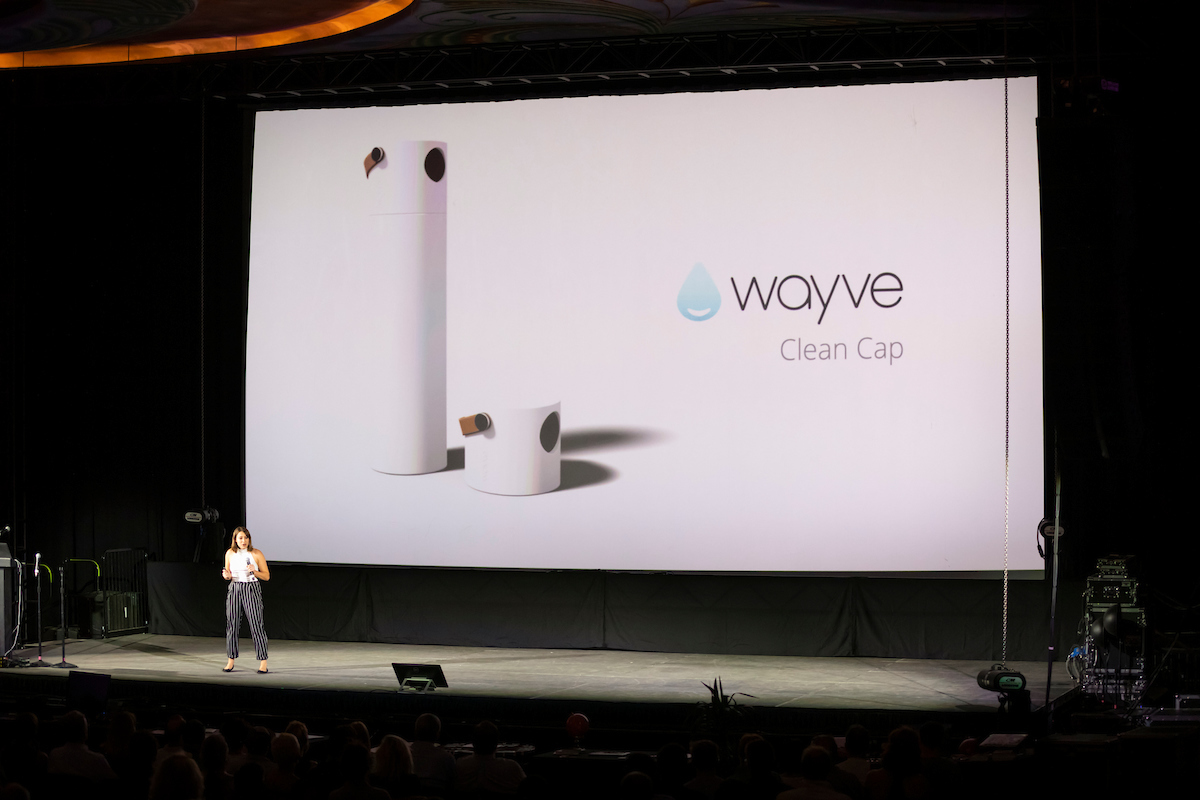
The Wayve team was able to utilize their $10,000 in startup funding from the Cal Poly Center for Innovation and Entrepreneurship (CIE) to prototype and patent their idea of a reusable water bottle that allows for filtered water from any spout.

While the business-development side of the program is what directly helped Wayve grow this idea into a company, she also believes the atmosphere of the HotHouse made the summer even more impactful.

“The best thing about the accelerator has to be the community,” the business entrepreneurship graduate said. “When you’re surrounded by all of that energy and other people working on their passions, it makes you all the more excited to pursue your own.”

Scolaro is grateful that she still has the support and motivation she needs to continue advancing her startup since graduating from the accelerator and joining the CIE’s two-year incubator.

“Now that we’re in the incubator program, it’s definitely not as much hand holding as the accelerator, but it’s not like all the support just disappeared,” she explained. “Working out of the HotHouse Annex, surrounded by other entrepreneurs, really provides an energy to keep the momentum going.”

Scolaro says her team really values the mentors, funding opportunities and network of helpful people they have now, but notes that a lot of these resources were first gained through the HotHouse Accelerator. That alone, she said, is enough of a reason to apply for the program.

Plus, she truly loves that the program allowed her to be an entrepreneur.

“I want to enjoy life and I want to enjoy work and I don’t want there to be a distinct separation between the two,” she said. “If I have the opportunity to create that for other people as well, to employ someone who loves what they do and feels like they’re contributing to an overall larger mission for the world, I would love to.”

So, to anyone considering taking their innovative ideas to the next level and building their business community, Scolaro has just one bit of advice for Cal Poly’s aspiring entrepreneurs.

“The HotHouse Summer Accelerator had to be one of the best summers of my life,” she said. “If you’re on the fence, just do it. There’s nothing to lose.” 

Take the leap, launch your dream business, and spend your summer in San Luis Obispo with the HotHouse Summer Accelerator. Find out more and apply for the program at https://calpolycie.wpengine.com/launch/hothouse-accelerator/

Comments are off for this post

Meet a CIE Incubator | Board Game Atlas

Trent Ellingsen, the CEO and co-founder of Atlas Alpha Inc., has created Board Game Atlas, a website that gives people all of the information they could need about board gaming.

“There are 37,000 board games on the site,” Ellingsen said. “You can find out all the information about them, like how many players they allow, how long the game takes, the description, user reviews, videos and the best prices.”

To begin the process of growing his company, Ellingsen joined the Cal Poly Center for Innovation and Entrepreneurship (CIE) Incubator program in November of 2018. His site initially had about 80 users at the time of its beta launch; now, after over a year in the incubator program and with the acquisition of a competitor, Board Game Atlas has about 54,000 users. 

Although he is a Cal Poly alumni, Ellingsen didn’t join the incubator program until years after graduating. In fact, he found the CIE through the power of networking.

“I found the incubator program, not because I had known about the HotHouse when I went to Cal Poly, but because a member of the HotHouse contacted me about working for his company,” he said. “I wasn’t interested in his company, but about a year later when I started my own, I remembered that it existed, so I applied and got in.”

For Ellingsen, connections are what got him to the incubator, and connections are a big part of why he’s loved working in the HotHouse.

“I think the best part of the incubator program are just the interactions with everybody,” he explained. “There’s different companies working on different things and at different stages, so it’s motivating. [It] makes me feel like I’m not coming to work by myself and on my own thing, but that I’m part of a bigger community and that I can grow friendships and relationships with the people around me.”

Not only has Ellingsen been able to grow his network since starting his startup journey in the incubator program, but the company itself has grown in size and success. 

By buying out a competing board game-centered site, he was able to add in more content to Board Game Atlas, grow the site’s user base and increase revenue. After taking on his company alone for some time, his team now consists of a co-founder and two part-time contractors.

While Ellingsen puts in the hard work to run his business, he credits some success to the CIE’s mentorship and consulting, as well as to the support of the San Luis Obispo community.

“If there’s a startup that’s wanting to get involved in the CIE, whatever stage you’re at, I think it’s definitely worth doing,” he said. “I think it’s worth building something here with different people who are starting companies. The community and the HotHouse are really supportive and it is a great way to get consultants and other advice in how to grow a company.”

If you’re feeling like it’s time to take advantage of all of the business services that the CIE HotHouse Incubator offers, why wait to apply. Start the journey to launching your best business at https://calpolycie.wpengine.com/launch/hothouse-incubator/.
Comments are off for this post

Where Are They Now? | Boost Acquisition

In 2014, Josh Hirahara, then-senior at California Polytechnic State University-San Luis Obispo, decided to jump into the entrepreneurial world. Within a year, he found himself immersed in his startup idea: a platform to connect for-sale-by-owner vehicle sellers and qualified buyers.

Hirahara began his journey by pitching his idea at Cal Poly Entrepreneurs’ Startup Weekend, later joining the Cal Poly Center for Innovation and Entrepreneurship (CIE) Hatchery program. Post-graduation, he continued to grow his idea into a functioning company, Boost Acquisition, through the summer-long HotHouse Accelerator program and two-year incubator program. 

“It was my senior year when I was getting into the entrepreneurship stuff, so I was late to the game,” explained Hirahara. “It’s been about five years since graduating and going through that program, but I left the area and my close CIE involvement about two years ago.”

Within those two years, Hirahara moved his business’s base to Salt Lake City, Utah, as well as opened an office in San Diego, California. Although far removed from San Luis Obispo, Hirahara still has connections from his CIE days.

“I’m still close to a lot of the people that I went through the CIE programs with and still keep in touch with people who run the programs,” Hirahara said. “I’m also partnered up with some older Cal Poly alumni and I consider us the founding group when I pitch our company now.”

Not only did Hirahara’s connections from the beginning stages of his career last, but so did the knowledge he gained from the programs.

“I was an industrial technology major, so I had some business background but knew nothing about entrepreneurship coming in,” he said. “It was great being able to go through the successive programs because I was advancing more than I could have by trying to learn everything on my own.”

Hirahara has now gone from learning the basics of the business model canvas to employing over 20 people at Boost Acquisition. His company is currently running market maker technology that connects in-market sellers with potential buyers online and in real-time. 

“We’re growing and it’s a long journey with a lot of pivots,” he expressed. “But it’s awesome seeing people want your product and pay you for it, making enough revenue to grow and hire more employees, and having a clear outlook on your goals for your company.”

While Hirahara and his team put in the work, he attributes the base of his growing company to the support and resources of the CIE, no matter how far he is now from the area it all began.

To read more about Josh Hirahara’s startup, visit https://www.boostacquisition.com/home.html.

See how you could be the next startup to grow with the Center for Innovation and Entrepreneurship’s support at https://calpolycie.wpengine.com/#launch.

Comments are off for this post

Wildnote revolutionizes fieldwork and protects natural resources | Meet a CIE Incubator

The digital world has revolutionized the way people from many industries do their jobs. Kristen Hazard, CEO of Wildnote Inc., a Center for Innovation and Entrepreneurship (CIE) incubating company, realized that biologists, botanists, archeologists and other scientists still used primarily pen and paper and largely missed out on the benefits of digital tools. This observation inspired her to launch Wildnote Inc., a mission-driven organization focused on enhancing and protecting natural resources by building the best-in-class, go-to digital platform for collecting, managing and reporting environmental data.

A typical day for biologists and other scientists conducting field work demands that they record data using pen and paper on the scene and then later manually transcribe their notes into a clunky PDF or Word document to send to a project manager. This transcribing can be tedious busy work after a long day on the field, but also leaves room for error.

Wildnote takes away the need for manual transcription, saving people time and allowing for consistent, real-time data across a team.

“This is a classic paper to digital play,” Hazard said. “It basically means we are revolutionizing the process of collecting, managing and reporting this kind of data.”

Utilizing the technology leads to higher efficiency, higher accuracy and the exact same type of information from each person out in the field. When the project manager gets the data, they are working in a web app. This means they can go to a photo gallery, look at the different data collected from a single spot and export that data.

Wildnote’s mission to protect and enhance natural resources doesn’t stop at creating digital solutions for biologists: the company is a registered B Corporation and a member of the 1% for the Planet program, which means Wildnote donates one percent of gross revenue to environmental organizations.

“If you have a business in San Luis Obispo, you aren’t doing it because housing is cheap, you’re here because of the nature,” Hazard said. “We have clean air, clean water, so why not keep giving back to the local natural resources in a simple way like becoming a member of 1% for the Planet.”

Wildnote started their entrepreneurial journey in San Luis Obispo with the Small Business Development Center, hosted by the CIE, and utilizing the free consulting available. The team then entered the incubator program, a two-year-long program open to community members and Cal Poly students alike.

“We found out that the CIE allows community companies,” Hazard said. “I like to call it the old folks incubator or the late bloomer incubator.”

The modern office space in downtown San Luis Obispo, the support of mentors and consultants, and the CIE’s creative, can-do energy are some of the Wildnote team’s favorite benefits. Access to investors and learning unfamiliar skills gave them the boost they needed to grow into the company they are today.

“I get a lot of people who come to me about launching a startup,” Hazard said. “The first thing I always say is to either apply for the SBDC or incubator program. If you can get in, you are immediately given all of these resources you need to grow the company.”

If your community startup is interested in receiving office space, gaining mentorship and joining a vibrant, energetic community of like-minded entrepreneurs, visit https://calpolycie.wpengine.com/launch/hothouse-incubator/ and explore the tools that empowered Wildnote to revolutionize their industry.


Comments are off for this post

Entrepreneurship Electrified | Cal Poly Alumni Create a New EV Power Solution

By: Lauren Arendt


Electric vehicles (EV) are taking the world by storm. NeoCharge, an incubating company in the Center for Innovation and Entrepreneurship (CIE), is working to provide better-charging solutions for residential EV owners. NeoCharge CEO Spencer Harrison and CTO Akhil Veluru designed their first product, a smart adapter for EV’s at home, to save EV owners time and money, ultimately making residential EV ownership more practical and accessible.

“As an [electric vehicle] owner, level two charging is crucial,” Harrison said. “Our product gives you the fastest way to get the affordable charging you need at home.”

The team says their residential focus is was sets them apart in the EV world. They focus on how people charge their EV’s at home, what that experience looks like and how to make it as seamless as coming home and charging a cellphone or laptop overnight.

“Whatever way we can make [charging EV’s] as seamless and convenient as possible,” Veluru said. “That’s really what our goal is.”

NeoCharge developed the first iteration of their product and currently allows customers to sign up for beta testing. They plan to make tweaks and add features based on customer feedback. WiFi functionality and software that lets customers choose whether they want to use renewable energy to charge their EV’s are on the short list of features they are already looking to add in the second round.

To prepare for manufacturing and the necessary safety testing preceding it, the NeoCharge team is in search of funds.

Harrison and Veluru didn’t get to where they are today overnight. They started their entrepreneurial journey alongside the CIE as a part of the hatchery program, an entrepreneurial epicenter on the Cal Poly campus where interdisciplinary groups of students congregate to solidify ideas, form teams and receive the early mentorship and guidance they need.

“There are tons of people to reach out to and tons of connections who can help you with anything that you need help in,” Harrison said. We’re new to this so getting help from other people is a huge thing that the CIE can provide.”

From the hatchery, the NeoCharge team entered the 13-week-long summer HotHouse accelerator program. Here, they not only received seed funding, but a network of peers, seasoned mentors and industry connections to get their company off the ground.

Today, NeoCharge can be found in the CIE HotHouse as a part of the two-year-long incubator program supported by mentorship and the vibrant CIE community.

“Definitely consider the CIE Incubator program,” Veluru said. “It’s a great way to get off the ground, especially if you’re new to running a startup. I didn’t know anything about running a startup when I first came here and I have learned a lot.”

You can learn more about the products offered by NeoCharge and even sign up to be a beta tester at www.getneocharge.com


Comments are off for this post
1 2 3 4