
Giving tech a second life: How GreenSight Technologies is tackling electronic waste
Every year, millions of electronic devices are discarded, many of which still have value. GreenSight Technologies, a startup founded by three California Polytechnic State University (Cal Poly) graduates, is working to ensure fewer of those devices go to waste.
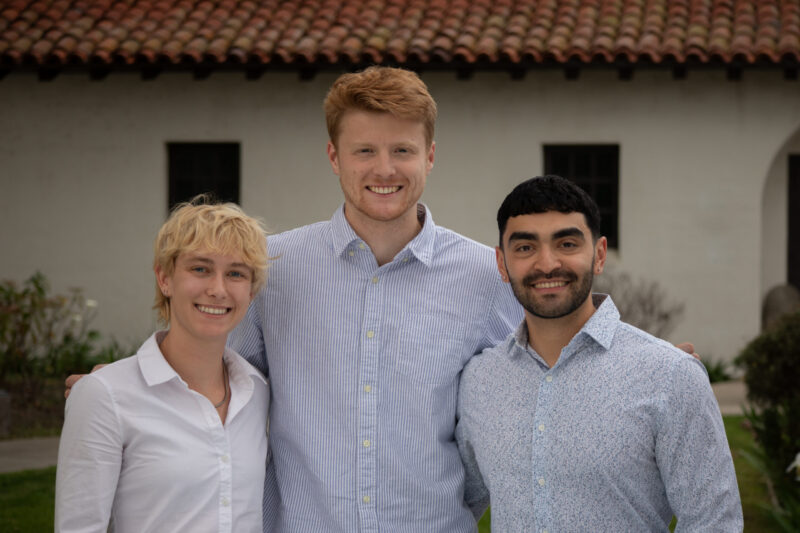
Founded by CEO Jake Daniels (General Engineering, ’24), CTO Diego Curiel (M.S. Electrical Engineering, ’26) and CPO Mackenzie Kettwig (Computer Engineering, ’24), GreenSight is building tools that help recyclers identify and evaluate used electronics, ensuring devices that still have value don’t end up in the waste stream.
“At GreenSight, we’re helping facilities sort and value used electronics faster and more accurately,” Daniels said. “We want to make sure that every device that deserves a second life actually gets it.”
The idea began at Cal Poly in an entrepreneurial senior project class, where the team set out to find the biggest problem they could solve and landed on electronic waste. The concept took shape when Curiel brought a collection of development boards to class, sparking a conversation about what happens to electronics once they are no longer in use. The team soon realized the scale of inefficiencies within the electronic waste industry and began exploring solutions.
GreenSight’s product allows technicians to take a photo of a device and instantly receive identifying and appraisal information, helping facilities determine whether an item should be resold, recycled or redirected through other channels. By streamlining this process, GreenSight reduces unnecessary waste while improving operational efficiency for its customers.
What sets GreenSight apart, Kettwig says, is a commitment to building with the customer at the forefront. “We’ve done hundreds of customer interviews and talked to many people in the industry,” they said. “We prioritize going to conferences and really connecting with who it is that we’re working with.” That customer-first approach also shapes how GreenSight presents its data with an emphasis on transparency so facilities can trust and rely on what they’re seeing.
The company’s transition from project to startup was heavily shaped by the Cal Poly Center for Innovation and Entrepreneurship (CIE). GreenSight first participated in Innovation Quest (iQ) 2024, a high-stakes competition where Cal Poly students pitch their innovative business ideas to a panel of judges in the hopes of winning funding for their startups.
This was the first time the team presented their idea outside of the classroom, and they didn’t place. “I think that was really good for us,” Curiel said. “It forced each of us to decide whether we really believed in what we were building. We did, which is why we kept going.”
From there, they joined the CIE Summer Accelerator, an intensive program that provides Cal Poly students and recent graduates with the resources necessary to turn their innovative ideas into full-fledged startups. Participants receive $10,000 in seed funding, as well as access to expert mentorship, entrepreneurial workshops and a dedicated workspace in the HotHouse, the CIE’s hub located in downtown San Luis Obispo.
The experience helped the team establish internal processes, refine their product and begin thinking more strategically about growth. After completing the Accelerator, GreenSight returned to iQ for a second time, earning the second-place Rich and Jackie Boberg Innovation Award of $10,000.
The decision to join the CIE Incubator after the Accelerator was deliberate and intentional. “It was really clear that we had a business on our hands, but the three of us knew that we couldn’t build it alone,” Curiel said. “We knew that the Incubator was going to offer the support and the resources that we needed to really take this to the next level — and it has totally come through on that promise.”
The Incubator is a two-year program that provides early-stage startups with workspace, mentorship and a collaborative environment designed to support growth. For GreenSight, that environment has been critical, not only in developing their product, but in learning how to operate as a company.
“We’ve been working out of the HotHouse for about two years through this program,” Daniels said. “Being surrounded by other founders who are going through similar challenges has been really powerful.”
For Kettwig, the Incubator has served as a home base where the team has launched and iterated on multiple products, weathered setbacks and relied on their support network to keep moving forward.
That persistence has translated into real traction. GreenSight now has a working product in use at multiple facilities and has expanded its team. Next, the founders are relocating to San Francisco, where they plan to tap into a larger pool of investors and opportunities. “The Incubator has done such a great job at preparing us for the next steps, and we’re looking for more investors and a bigger pool of opportunity to continue taking the company in the right direction,” Kettwig said.
After several years of research and development, GreenSight’s focus is shifting. “We now have a handful of customers all around the world, and we’re trying to expand our reach,” Curiel said. “The problem that we’re solving is global and it deserves a global solution.”


