
AwareNet: The startup filling the critical gap in emergency response
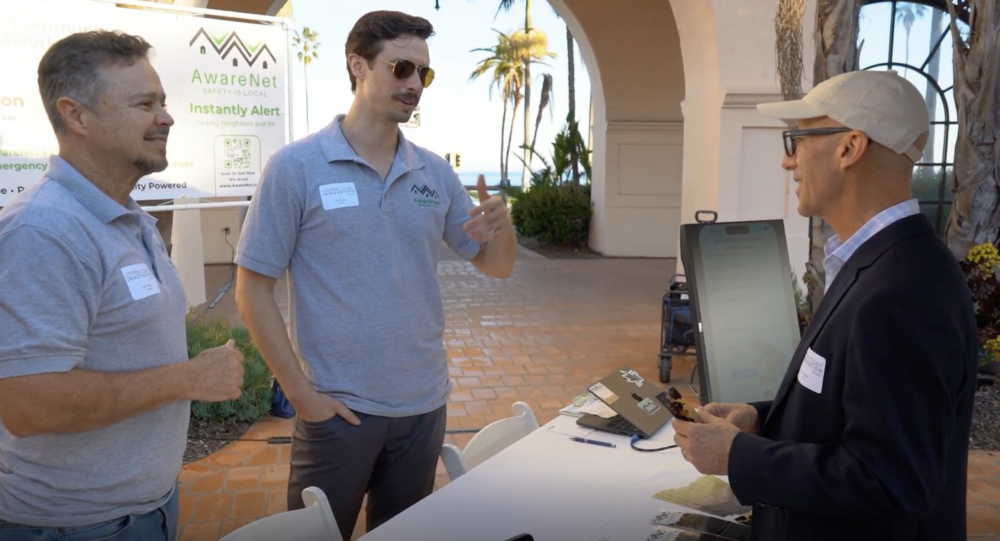
The inspiration behind AwareNet traces back to observations made by Sam Veazey in the mid-1980s, when he envisioned a tool that could help communities respond to emergencies by connecting neighbors in moments of crisis faster than traditional dispatch systems allowed. At the time, the technology to build it simply didn’t exist yet.
Decades later, his son and now co-founder Jake Veazey (Computer Science, ’19) picked up where that vision left off and acts as the company’s CEO. His father serves as the other co-founder and CFO, bringing an extensive multidisciplinary background to the venture, holding an MBA in finance, a master’s degree in biomedical engineering and bachelor’s degrees in biology and mathematics.
After Jake Veazey earned a computer science degree at California Polytechnic State University (Cal Poly) and spent seven years at Amazon building cybersecurity tools for AWS, he had both the technical foundation and the industry experience to finally bring his father’s idea to life. When the COVID-19 pandemic highlighted just how disconnected communities had become, the urgency became impossible to ignore. In March 2025, Jake Veazey officially began building AwareNet and transitioned into the venture full-time through the Cal Poly Center for Innovation and Entrepreneurship (CIE) Incubator program.
The CIE Incubator is a two-year program that includes everything needed for early-stage companies to develop into financially stable, high-growth enterprises by providing the tools, training and infrastructure that help facilitate smarter, faster growth.
AwareNet is building real-time safety networks for individual neighborhoods, designed to fill the critical gap between when an emergency happens and when professional help arrives. That window, on average, is seven to 14 minutes. With more than 240 million 911 calls placed every year, that gap represents an enormous opportunity to save lives. AwareNet contacts a user’s connected community, 911 and friends and family simultaneously, mobilizing help within seconds rather than minutes.
What sets AwareNet apart from existing solutions is its focus on privacy and accessibility. Unlike platforms that broadcast emergencies publicly or charge monthly fees, AwareNet keeps information secure, sharing it only when and where it is needed — and it is completely free to use. “Solutions like Pulse Point and Life 360 are great, but they are either too niche or too broad,” Jake Veazey said. “We work before the call even gets to dispatch, and we keep your information as private as possible.”
Transitioning from a structured corporate environment to the uncertainty of a startup was smoother than Jake Veazey expected. His time at Amazon, where his team operated with a startup mentality despite having significantly more resources, prepared him well for the technical side of building AwareNet. The business side, however, was a different story.
“Learning the business side as a non-business major — marketing, go-to-market strategy, how to handle customers, how to sell — I don’t think I could have done it without the Incubator,” he said. “Anyone can build a project, but you need help to build a company. Being part of the Incubator forces you to think bigger, act faster and constantly iterate with a feedback loop from mentors and advisors who have been there before. It really teaches you not just what you’re building, but why.”
Two advisors in particular have made a significant impact. Their lead mentor, Mitch Emerson, has been a steady guide through the complexities of running a startup, while public relations advisor Becky Mosgofian has helped the team sharpen how they communicate AwareNet’s mission to the world. “The mentors and advisors here have all been a major part of learning what it takes to run a business,” Jake Veazey said.
Since joining the Incubator, AwareNet has grown from a concept into a functioning product with a beta launch on the horizon. The team is preparing to roll out on the Central Coast, working directly with neighborhoods and homeowners associations to deploy the platform in real communities. “The Incubator is probably one of the fastest ways anyone can go from an idea to an actual product,” Jake Veazey said of the program. “You can’t find any other program that gives you such a solid foundation over two years.”
Their goal is simple: make AwareNet the trusted safety layer for neighborhoods across the country by providing a free, accessible tool that helps communities respond before the first responders arrive.
“We want the name AwareNet to be synonymous with emergency response in your community,” Jake Veazey said. “A tool that is not only free to use, but accessible, giving people who didn’t necessarily have the ability to get help the means to get it.”


